
Indian benchmark indices Sensex and Nifty surged significantly in early trade, tracking a global rally fueled by US President Donald Trump's declaration of an end to the war with Iran and a subsequent drop in crude oil prices.

US Vice President JD Vance on Friday dismissed reports suggesting that Iran would receive financial incentives merely for signing the peace deal between Washington and Tehran aimed at ending the hostilities in West Asia, calling such claims "fake information".

Seattle's LGBTQ community members say they hope that this Friday's World Cup "Pride Match" between Egypt and Iran, two countries where homosexuality is criminalised, can be an opportunity to change minds.

Israel's Defence Minister Israel Katz declared that the Israeli military will not withdraw from its security zones in Lebanon, Syria, and Gaza, directly opposing the newly announced American-led diplomatic framework with Tehran. National Security Minister Itamar Ben-Gvir further asserted Israel's sovereignty, stating, "Trump's agreement does not bind us. Israel is not subject to the United States, and we are an independent and sovereign nation!"

We are back to the 1971 moment with both China and the US supporting Pakistan, asserts Colonel Anil A Athale (retd).

US President Donald Trump on Sunday said that the Israeli strikes on Lebanon's capital of Beirut "should not have happened", warning that such escalation could jeopardise the peace agreement with Iran to achieve a complete solution to the West Asia conflict, which, according to him, is within reach.

Indian benchmark indices, Sensex and Nifty, closed flat on Friday, with elevated crude oil prices due to geopolitical uncertainties and a rebound in US Treasury yields making investors cautious and preventing a decisive market rally.

Iran's soccer team arrived in the United States for the first time at this World Cup on Sunday, landing at Los Angeles International Airport and holding a press conference on the same day that a peace deal between the two nations was announced.

The White House has not announced any decision following US President Donald Trump's meeting with his national security team regarding Iran, despite Trump's earlier indication that the discussion would lead to a 'final determination' on the matter.

Iran has dismissed US President Donald Trump's assertion that Iran was responsible for a drone attack on Indian ships in the Strait of Hormuz as 'simply baseless'. The Iranian embassy stated that Trump's comments were an attempt to deflect attention from recent US military strikes on merchant vessels in the Gulf of Oman, which resulted in the deaths of three Indian mariners.

Indian benchmark stock indices, Sensex and Nifty, extended their winning streak for a third consecutive day, driven by positive global market trends and a significant softening of crude oil prices following a peace deal between the US and Iran.

Donald Trump expressed optimism about securing an agreement with Tehran to prolong a truce and restore transit through a strategic maritime chokepoint within the next week, even as he criticised political opponents and the media for what he described as their tendency to distort outcomes, even in a hypothetical scenario of complete Iranian military surrender.

Pakistan's Interior Minister Mohsin Naqvi visited Tehran for the third time recently to mediate peace amidst rising tensions between the US and Iran. Pakistan is actively leading diplomatic efforts to de-escalate the conflict in West Asia, which has impacted global energy markets and trade.

US President Donald Trump has accused Iran of bringing down an American military helicopter near the strategically vital Strait of Hormuz, prompting a strong declaration that the United States 'must' respond to this significant incident.

Iran's Islamic Revolutionary Guard Corps (IRGC) has claimed to have targeted and destroyed hangars of F-35 fighter jets and struck 21 American air and naval bases across West Asia and the Gulf region, including the US Army's command and control centre at the Al-Azraq base in Jordan and the US Fifth Fleet headquarters in Bahrain.
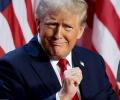
US President Donald Trump announced that a deal to end the war with Iran would be signed on Sunday, with the strategic Strait of Hormuz immediately becoming 'open to all'. This follows indications from Pakistan that negotiations were in their final stages, though Iran has yet to comment on the timeline.

In a lengthy post on Truth Social, Trump said negotiations with Iran were 'proceeding nicely' and argued that several Muslim and Arab nations should formally recognise Israel and join the Abraham Accords once a deal is reached.

Indian benchmark equity indices, Sensex and Nifty, extended their rally for a fifth consecutive session, driven by optimism surrounding a potential US-Iran peace deal and a significant drop in crude oil prices. Despite hawkish remarks from the US Fed, investors remain hopeful that easing energy prices could temper inflationary pressures.

Iranian Foreign Ministry spokesperson Esmail Baghaei stated that Iran is instead working with Oman to establish a mechanism for the safe passage of ships through the Strait.

Pakistan Prime Minister Shehbaz Sharif announced that a US-Iran peace deal is on the verge of finalisation, potentially within the next 24 hours, marking a significant diplomatic breakthrough after months of intense negotiations.

Following a Memorandum of Understanding between the US and Iran to resolve the West Asia conflict, eleven India-bound vessels have successfully transited the Strait of Hormuz. This development signals a positive shift for maritime trade, with more Indian-flagged ships expected to pass through the crucial waterway soon.

Indian benchmark indices, Sensex and Nifty, continued their downward trend for the fifth consecutive day, with the Sensex dropping 281 points and Nifty falling 78 points, primarily driven by surging crude oil prices and persistent geopolitical tensions in West Asia.

India has been drawn into Group E of the AFC U-17 Men's Asian Cup Qualifiers, alongside hosts Malaysia, Palestine, Singapore, and Guam. The qualifiers will take place in Malaysia from November 11 to 20, with India aiming for their 11th appearance in the main tournament, scheduled for Uzbekistan in 2027.

US President Donald Trump is reportedly considering launching fresh strikes against Iran if ongoing negotiations fail to produce a peace deal, according to US media outlet Axios. This development comes as diplomatic efforts continue, with Pakistan and Qatar attempting to broker an agreement.

Indian benchmark equity indices, the Sensex and Nifty, bounced back significantly, with the Sensex climbing 628 points and the Nifty snapping its seven-day losing streak, driven by easing global bond yields and fresh foreign fund inflows.

Iran's football federation announced its World Cup ticket allocation has been revoked just days before the tournament, leaving many fans unable to attend.

Indian benchmark indices, Sensex and Nifty, recovered intraday losses to close higher, driven by late-day buying and a significant decline in Brent crude oil prices, which fell 3 per cent to USD 89.32 per barrel.

Amid ongoing ceasefire negotiations, Israel is on high alert, fearing a potential surprise missile and drone attack from Iran targeting Gulf countries and Israel, according to intelligence officials.

The Kuwaiti Army reported intercepting hostile missile and drone attacks, while tensions escalate between the US and Iran with reported strikes and confrontations near the Strait of Hormuz.
Som Kumar Tamang, a 44-year-old Nepalese driver from Terhathu district, was killed in a drone attack in Kuwait. The attack, attributed to Iran, occurred amidst US military action against Iran. The Nepalese Embassy in Kuwait is arranging for the repatriation of his body and has advised Nepalese nationals in Kuwait to observe security protocols.

A lesson for India is to clearly define objectives beforehand, so that the adversary or other parties do not attempt to mitigate them midway.

The Gulf countries on Monday welcomed a peace deal reached between the US and Iran to end their conflict and called for protection of maritime routes and freedom of international navigation, including the uninterrupted flow of traffic through the Strait of Hormuz.

Iranian media reported an exchange of fire between Iranian and US forces near the Strait of Hormuz, amidst a shaky ceasefire between the two countries.

Mexican President Claudia Sheinbaum said on Monday her government agreed to allow the Iranian national football team to stay in Mexico during the World Cup, adding that the United States did not want to host the team.

'India was the emirate's largest international source market by hotel guest volume.'

The United States military and Kuwaiti air defence forces successfully intercepted multiple Iranian ballistic missile and drone attacks targeting Kuwait and Bahrain, with Iran's state broadcaster claiming American military installations in Kuwait were deliberately targeted.

Iran's Foreign Ministry spokesperson Esmaeil Baghaei has accused the United States of frequently changing its positions and complicating efforts to reach an understanding, stating that these shifts disrupt diplomatic processes and prolong negotiations. He also linked any potential agreement with the US to an immediate ceasefire in Lebanon, accusing Israel of escalating conflict to derail diplomatic efforts.

United States Central Command (CENTCOM) forces have conducted a 'heavy wave of strikes' against numerous Islamic Revolutionary Guard Corps (IRGC) targets in Iran. This action was a direct response to attempted Iranian missile strikes on US forces in West Asia, which were successfully intercepted. The strikes targeted IRGC military command centres, missile and drone facilities, coastal surveillance, and maritime capabilities, aiming to reduce threats posed by Iran and its proxies. US President Donald Trump also issued strong warnings to Tehran, linking the escalation to a recent drone strike on an LNG vessel in Egypt's Damietta Port.

Iran will play their final World Cup warm-up behind closed doors in Turkey on Thursday before departing for their tournament base in Mexico on Saturday.

A potential agreement between the United States and Iran, including a comprehensive ceasefire and gradual lifting of US sanctions, may be announced soon, according to reports. The agreement aims to de-escalate tensions and establish a framework for resolving disputes.
